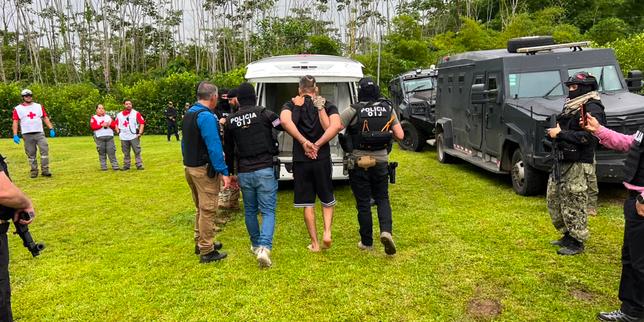
About two thousand five hundred bullets flew through the humid morning air in Rio Frio. That is what it took to finally stop Alejandro Arias Monge. You might know him better by his alias, El Diablo. For a decade, Costa Rica's most wanted drug trafficker managed to slip through police cordons, hide out across borders, and build a violent transnational empire.
That streak ended on a rural property in the northeastern province of Heredia.
Attorney General Carlos Diaz confirmed that the raid targeted a high-level meeting of criminal syndicate leaders. It was not a quiet arrest. It was a small war. Eight police officers sustained injuries, with one federal agent left in serious condition. Another criminal figure, Roney Rios, died at the scene during the fierce exchange. When the smoke cleared, authorities hauled away high-powered rifles, pistols, and drone monitoring equipment.
El Diablo is finally in custody. But his capture reveals a much harder truth about Central America's changing security dynamics.
How a Decade-Long Manhunt Finally Collapsed
For ten years, Arias Monge treated Costa Rica as his personal playground. He became a ghost with a 500,000-dollar bounty on his head from the United States State Department. Drug Enforcement Administration records show his syndicate operated across all seven provinces of the country. They functioned as a critical logistics hub, moving narcotics originating in Colombia upward through Honduras and Guatemala, feeding the massive appetite of the Mexican cartels and ultimately the United States market.
Local authorities estimate he was linked to roughly one hundred deaths. His playbook relied on absolute terror. Members of his syndicate posted videos of murders on social media just to keep local populations too terrified to speak to investigators. He also mastered the art of evading capture through a mix of bribery, intimidation, and frequent escapes into neighboring Nicaragua.
Yet, criminals eventually grow comfortable. They hold meetings. They gather in person. Law enforcement exploited that exact vulnerability in Rio Frio.
The Shifting Reality of Costa Rican Security
We need to talk about what this arrest actually means for the region. Costa Rica spent decades proudly holding the title of Central America's safest country. Citizens took pride in having no standing army and relatively low violent crime rates compared to their northern neighbors.
Those days are gone.
The rise of figures like El Diablo proved that international cartels found a comfortable home in local backroads and coastal towns. Drug trafficking routes shifted south, transforming a peaceful nation into a fierce battleground for international supply chains. When a single local drug bust requires thousands of rounds of ammunition and leaves nearly a dozen law enforcement agents wounded, you know the threat has evolved past standard local policing.
The United States embassy quickly congratulated the Costa Rican government on the operation. They had every reason to celebrate. Taking out a transnational logistics coordinator disrupts the flow of multi-tonne shipments. But arresting one man doesn't erase the infrastructure he built.
What Happens Next in the Drug War
When a kingpin falls, a vacuum opens up immediately. Lieutenants fight for control. Splinter groups form. Violence often spikes in the short term as rival factions try to claim the territory left behind by the fallen leader.
Costa Rican federal agents now face the daunting task of dismantling the remaining cells scattered across the provinces. They seized the high-powered firearms and the drones, but the financial networks, local informants, and corruption channels remain active.
El Diablo thought he could outrun the law forever. He survived ten years of intensive manhunts, police corruption investigations, and international pressure. Friday morning proved that even the most elusive ghosts eventually run out of bullets and luck.