Twenty-eight people went to work on a Thursday morning in Jinjiang and never came home. They died trapped inside a multi-story shoe factory, swallowed by a toxic fire that tore through layers of rubber, leather, and synthetic glues. This wasn't a freak accident. It was a predictable disaster in a city that manufactures one out of every five athletic shoes on earth.
The fire at the Huiteng Shoes factory on Kaituo Road East highlights a persistent issue. Despite repeated government promises to overhaul safety protocols, Chinese manufacturing hubs remain highly dangerous. Economic speed regularly overrides worker safety. When you prioritize massive volume and razor-thin margins, safety regulations often get treated as optional paperwork rather than life-saving rules.
A Midday Inferno in Jinjiang
The disaster started around noon. At exactly 12:04 PM on July 9, 2026, emergency calls flooded the local dispatch center in Chendai township. The timing was disastrous. Many workers were eating lunch or resting inside the facility. Within minutes, a small spark on the ground floor found an endless supply of fuel.
Location: Huiteng Shoes Factory, Jiangtou Village, Jinjiang City, Fujian Province
Time of Outbreak: 12:04 PM
Initial Death Toll: 28 people
Emergency Personnel: 183 rescuers, 35 vehicles
The ground floor of a shoe factory is basically a bomb waiting to go off. It holds massive stockpiles of highly flammable materials. Polyurethane sheets, rubber soles, synthetic fabrics, and barrels of volatile chemical adhesives are packed tightly together. Once the fire hit those chemical stores, the building stood no chance.
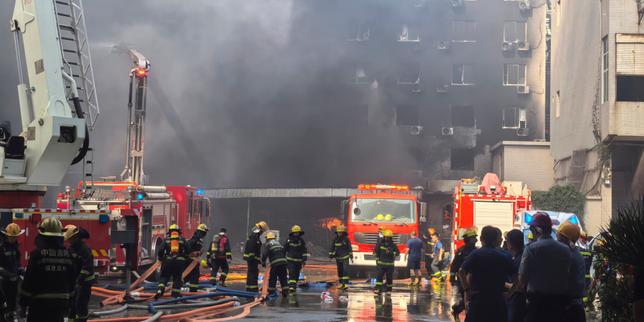
Witnesses outside captured horrific footage that quickly spread across Chinese social media networks. Towering sheets of orange flame licked the sides of the multi-story structure. A column of thick, pitch-black chemical smoke surged hundreds of feet into the air. Trapped workers crowded onto the narrow rooftop, waving frantically at crowds below while toxic fumes rolled over them.
Local authorities in the neighboring city of Quanzhou scrambled 183 firefighters and 35 emergency vehicles to the scene. By the time they arrived, the lower levels were completely engulfed. The intense heat and blinding smoke made entering the building almost impossible. Firefighters spent hours battling the flames from the outside, trying desperately to reach the upper floors and the roof where survivors clung to life.
Flammable Materials and Trapped Workers
The physical composition of a modern shoe makes it a nightmare for fire rescue teams. Manufacturing sneakers requires massive quantities of solvent-based adhesives. These glues release heavy, volatile organic compounds into the air during the bonding process. When these chemicals burn, they don't just produce smoke. They create a dense, acidic vapor that burns the eyes, throat, and lungs on contact.
State broadcaster CCTV noted that the fumes at the Jinjiang site were so intensely pungent that rescue workers struggled to see or breathe even with specialized gear. For the workers trapped inside without oxygen masks, a few breaths of that toxic cloud meant instant disorientation or death.
Many industrial buildings in China use a multi-tiered setup. The ground floor serves as storage, the middle floors act as assembly lines, and the upper levels or adjacent structures sometimes double as cramped worker dormitories. This vertical arrangement creates a deadly chimney effect. When a fire breaks out on the bottom floor, the heat and smoke naturally rush upward through open stairwells and elevator shafts. It cuts off the primary escape routes before the people upstairs even realize they are in danger.
By late afternoon, the open flames were mostly extinguished, leaving behind a charred, blackened shell. The outer facade was completely ruined. But the danger inside hadn't stopped. Rescue teams faced structural instability and pockets of extreme heat that prevented them from clearing every room. The official death toll stalled at 28, but emergency officials openly admitted they lost communication with several people known to be inside when the fire broke out.
The Broken Chain of Industrial Safety
The political fallout from the Jinjiang fire was immediate. Chinese President Xi Jinping issued public instructions demanding an all-out search and rescue effort. He acknowledged the heavy human losses and insisted that authorities must establish strict accountability.
Local police acted fast to show compliance. The owner of Huiteng Shoes and several top factory managers were taken into custody within hours. The local government immediately froze the company's bank accounts to secure compensation funds for the victims' families. This rapid legal crackdown is a standard script for Chinese officials after a major disaster. They lock up the local bosses, issue stern warnings, and promise structural changes.
The core issue isn't a lack of laws. China has plenty of regulations on paper. The Ministry of Emergency Management and the National Fire and Rescue Administration have detailed rulebooks covering material storage, fire exits, and ventilation systems. The real breakdown happens at the local level.
Local municipal governments face conflicting goals. They are pressured to maintain high economic growth, protect local tax revenues, and keep employment numbers steady. Jinjiang is known as China's shoe capital for a reason. The city produced over 1.2 billion pairs of shoes in 2024 alone. It drives the local economy. Forcing small and medium-sized factories to invest in expensive automated sprinkler systems, fireproof storage lockers, and proper ventilation can push them out of business. Local inspectors frequently look the other way or accept superficial fixes during routine safety audits.
A Broader Trend of Factory Disasters
This shoe factory fire isn't an isolated incident. It belongs to a much larger, ongoing pattern of industrial negligence that continues to plague the manufacturing sector.
Just look at the broader numbers. During the first three quarters of 2024, China recorded more than 13,400 workplace safety accidents. Those incidents caused 12,804 deaths. Think about that for a second. That is an average of nearly 50 people dying every single day just trying to earn a living in factories, mines, and construction sites.
The government tried to clean things up recently. Beijing launched a massive nationwide campaign to eliminate severe fire hazards after a fire in a Hong Kong residential complex killed 168 people. But that campaign clearly hasn't fixed the deep cultural and systemic issues within the industrial supply chain.
Consider a few other recent examples that show how widespread this danger really is:
- A major explosion at a fireworks manufacturing plant killed 26 workers and injured 61 others.
- A gas explosion at a coal mine claimed the lives of 82 miners trapped underground.
- An apartment building fire in southern Guangdong province killed 12 people.
- A fire at a nursing home facility in northern China left 20 elderly residents dead.
Every single one of these tragedies follows the exact same path. There is a lack of basic safety equipment, blocked or locked emergency exits, illegal storage of hazardous materials, and slow emergency responses. The Huiteng factory fire checks every single one of those boxes.
The Real Cost of Global Consumer Goods
Western consumers like to pretend that supply chain ethics solved these problems years ago. We look for corporate social responsibility statements and green checkmarks on corporate websites. But the reality on the ground in manufacturing towns like Chendai tells a very different story.
Global brands demand lower prices and faster turnaround times. To survive in that environment, subcontracted factories cut corners wherever they can. They buy cheaper, more volatile chemical glues. They pack warehouses past legal capacities. They skip regular fire drills because stopping the assembly line for an hour costs money.
When a brand squeezes a supplier on price, something has to give. It is almost never the owner's profit margin. Instead, it is the worker's physical safety. The 28 people who died in Jinjiang paid the ultimate price for that systemic pressure.
What Needs to Change Right Now
If Chinese authorities want to stop these horrific fires, they have to move past empty rhetoric and post-incident arrests. Real reform requires shifting how local officials are evaluated and how factories are monitored.
First, local safety inspectors must be independent of local economic boards. As long as the people auditing a factory are evaluated based on the city's GDP growth, they will never enforce shutdowns for safety violations. Inspectors need the authority to close non-compliant facilities instantly without political interference.
Second, the storage of raw chemical materials must be physically separated from assembly lines. Putting thousands of pounds of flammable adhesives on the ground floor of a building filled with hundreds of workers is a recipe for mass casualty events. Material warehouses must be standalone, single-story structures built with specialized fire-suppression systems.
Finally, international brands must take direct responsibility for the physical infrastructure of their suppliers. Auditing financial records isn't enough. Brands need to fund infrastructure upgrades, like external fire escapes and automated sprinkler systems, rather than simply demanding compliance from underfunded local operations.
To prevent the next industrial disaster, start tracking the manufacturing history of the brands you buy. Look for companies that provide transparent, third-party verified safety data for their overseas facilities. True safety requires continuous oversight and a willingness to pay the real cost of human labor.