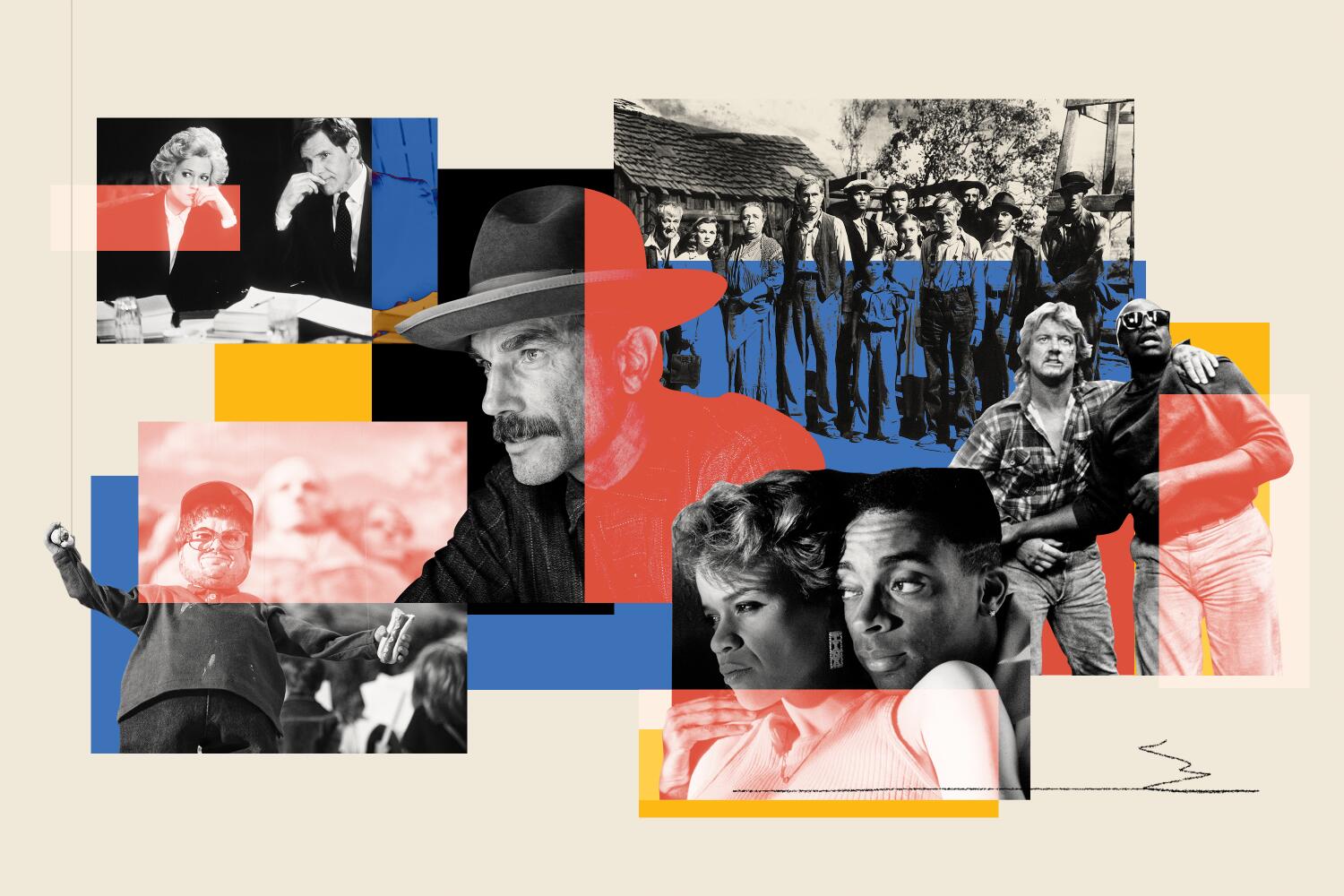
Movies don't just reflect the mood of the country. They usually catch it right when the floorboards start to rot. When we look back at the most intense cultural shifts over the past century, standard history textbooks give us the legislation and the casualty counts, but Hollywood tells us how it actually felt to live through the fallout.
Right now, as the country hits its semiquincentennial mark, it's easy to get caught up in a selective, sanitized memory of how we got here. We like to pretend that national change happens smoothly. It doesn't. It's loud, messy, and usually leaves a lot of people behind.
If you want to understand the real friction points where the old version of America collided with whatever came next, you have to look at the stories that didn't blink. These ten foundational movies capture those exact moments when the ground shifted permanently beneath our feet.
The Broken Promise of the Dirt
We like to talk about the American dream as an upward trajectory, but sometimes the bottom drops out completely. In 1940, John Ford took John Steinbeck's novel The Grapes of Wrath and turned it into an unvarnished mirror for a broken nation.
Film: The Grapes of Wrath (1940)
Director: John Ford
The Shift: The Great Depression and the death of agrarian independence
The movie tracks the Joad family as they get pushed off their Oklahoma land by bank-owned tractors and forced onto the dusty highway toward California. Henry Fonda plays Tom Joad with a quiet, simmering anger that completely cuts through the typical studio sheen of the era.
What makes this film stick with you isn't just the economic misery. It's the total collapse of the myth that if you work the soil, the soil will take care of you. When Muley Graves sits crumpled in the dust, watching a bulldozer flatten his home because a bank somewhere across the country signed a piece of paper, you are watching the birth of modern corporate displacement. It's an uncomfortable reminder that in the face of raw capital, history and sweat don't mean a thing.
The Quiet Panic of Post-War Victory
We're conditioned to view 1945 as a time of pure celebration. The war was won, the economy was about to boom, and the future looked bright. But William Wyler's The Best Years of Our Lives came out in 1946 and exposed the massive, unspoken psychological rift waiting for veterans at home.
The story follows three men returning to the same small midwestern town. One is a wealthy banker who now sees the cold absurdity of commercial loan algorithms after witnessing raw human sacrifice. Another is a decorated captain who can only find work as a low-wage soda jerk. The third is played by Harold Russell, a real-life veteran who actually lost both hands in the war.
Wyler doesn't give us cheap Hollywood heroism. He shows a man struggling to put on his hooks in the morning, terrified that his high school sweetheart is marrying him out of pity. The movie captured a profound truth that politicians ignored: you can't just turn off a global war and expect men to slide right back into their old lives without a hitch.
The Deathbed of Corporate Sanity
By the mid-1970s, the post-war optimism was completely dead, replaced by the cynicism of Watergate, the Vietnam War, and runaway inflation. Sidney Lumet's Network caught this exact moment of national exhaustion and turned it into a dark, prophetic satire.
Film: Network (1976)
Director: Sidney Lumet
The Shift: The monetization of public rage and corporate media consolidation
When news anchor Howard Beale unravels on live television and tells his audience to yell that they're mad as hell, he isn't just a crazy old man venting. He's channeling a collective nervous breakdown.
The brilliant, terrifying twist of Paddy Chayefsky's script is that the network doesn't take Beale off the air. They package his fury. They sell it to sponsors. Lumet saw exactly where the country was heading: an era where news is treated as entertainment, outrage is a commodity, and global corporations wield far more power than any elected government. Honestly, watching it today feels less like a satire and more like a documentary about how our current media environment functions.
The Hustle That Replaced the Factory
The late 1980s gets remembered for big hair and neon, but underneath the surface, the American economy was fundamentally rewriting its rules. Mike Nichols's Working Girl looks like a standard romantic comedy on the outside, but it's secretly one of the sharpest postmortems of the shift from a manufacturing economy to a financial service hustle.
Melanie Griffith plays Tess McGill, a Staten Island secretary trying to break into the white-shoe world of Wall Street mergers and acquisitions. The movie captures the hyper-competitive, shoulder-padded corporate climate where traditional loyalty was discarded in favor of hostile takeovers and speculative deals.
Tess has to change her hair, her clothes, and her accent just to get a foot in the door. It highlights a massive cultural realization: the old path of working hard at a single company for thirty years was gone. If you wanted to survive in the new America, you had to reinvent yourself, cut out the sentimentality, and learn how to pitch.
The Toxic Extraction of Wealth
Paul Thomas Anderson's There Will Be Blood takes us back to the turn of the twentieth century, but its focus is entirely on the ruthless economic engine that defined modern American power. Daniel Day-Lewis delivers an absolute monster of a performance as Daniel Plainview, an oil prospector who views human relationships as minor obstacles to be cleared away.
Film: There Will Be Blood (2007)
Director: Paul Thomas Anderson
The Shift: The triumph of unbridled resource extraction over community and faith
The movie chronicles the birth of the oil industry, tracking how a single-minded pursuit of black gold corrupts everything it touches. Plainview's rivalry with a young local preacher shows the uneasy, often hypocritical alliance between corporate greed and religious institutionalism in building the West.
Anderson doesn't offer any comforting lessons here. The film ends in a gaudy, isolated mansion, showing that the ultimate conclusion of this hyper-individualistic obsession isn't glory. It's just total, violent isolation.
The Suburban Isolation of the Cold War
While the 1950s is often painted as a golden age of backyard barbecues and nuclear families, Sam Mendes's Revolutionary Road pulls back the manicured lawns to show the immense psychological toll of forced conformity.
Leonardo DiCaprio and Kate Winslet play a young couple living in a Connecticut suburb, slowly suffocating under the weight of expectations they don't actually believe in. The film documents the exact moment when the American middle class traded its eccentricities and grand ambitions for corporate stability and consumer comfort. The tragedy isn't that their lives are terrible; it's that their lives are perfectly comfortable, yet completely empty.
The Fractured Rhythm of the New South
Robert Altman's Nashville is a five-day mosaic set against the backdrop of the Tennessee country music industry, capturing a country that has completely lost its moral compass in the wake of political assassinations and foreign intervention.
Released in 1975, the film uses 24 main characters to show how celebrity culture, political campaigning, and commercial music became hopelessly tangled together. Altman uses a revolutionary multi-track recording system where characters constantly talk over one another. You don't get neat, orderly monologues. You get a chaotic wall of sound that perfectly mirrors a country that had stopped listening to itself.
The Cybernetic Paranoia of Suburbia
Sometimes a sci-fi B-movie hits closer to the bone than any prestige drama. John Carpenter’s They Live arrived in 1988 as a direct, angry punk-rock middle finger to the economic policies of the decade.
Film: They Live (1988)
Director: John Carpenter
The Shift: The subliminal consumerism of late-stage capitalism
Roddy Piper plays a nameless construction worker who finds a pair of sunglasses that let him see the world as it really is: a black-and-white landscape where billboards actually read "OBEY" and "REPRODUCE," and the ruling class is literally made up of skull-faced aliens. Carpenter didn't bother with subtle metaphors. He made a loud, funny, deeply cynical film about how mass media and consumer culture can numb the public into accepting massive economic inequality without a fight.
The Disappearing Horizon of the West
The western genre used to be about building a nation, but the Coen brothers' No Country for Old Men is about watching that nation run out of gas. Set in 1980 on the Texas border, the film tracks the total breakdown of the old-school law and order that supposedly tamed the frontier.
Tommy Lee Jones plays Sheriff Ed Tom Bell, a man who realizes he is completely outmatched by a new, senseless brand of criminal violence represented by Javier Bardem’s Anton Chigurh. The vast, empty desert landscapes aren't full of promise anymore. They're just lonely spaces where old structures of meaning don't apply, leaving the older generation to realize that the world has changed into something they can no longer comprehend.
The Digital Erasure of Connection
We close the loop with David Fincher's The Social Network, a film that looked at the dawn of the 2000s tech boom and correctly predicted exactly how it would break our social fabric.
Film: The Social Network (2010)
Director: David Fincher
The Shift: The monetization of human relationships through digital platforms
Jesse Eisenberg’s portrayal of Mark Zuckerberg isn't just a portrait of a tech founder; it's a look at a new kind of power structure where coders replace oil barons. Fincher and screenwriter Aaron Sorkin showed us that the platform built to connect the world was actually born out of pettiness, exclusion, and an inability to connect on a basic human level. It marks the precise moment American life migrated from physical communities to online spaces governed by private algorithms.
To truly understand how these cinematic shifts translate to real history, your next step should be moving past the screen. Pick one of these eras and look up the contemporary local newspaper front pages from the week these films were set to see how closely the fiction matched the daily reality of the people who lived it.