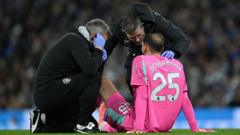
You have seen it happen a hundred times. A team is defending a narrow lead in the final ten minutes. The opposition is piling on pressure, corner kicks are raining in, and the stadium noise is deafening. Suddenly, the goalkeeper drops to the turf clutching a knee or a hamstring.
Play stops instantly. The physio jogs onto the pitch with a magic sponge while outfield players sprint to the technical area. Managers hand out fresh tactical instructions, players gulp down water, and the defensive shape gets completely reset. It is one of the most blatant, cynical dark arts in modern football.
English football has finally had enough. The Football Association, the Premier League, the English Football League, the National League, and the Women’s Super League have all agreed to back a radical new trial designed to kill off these fake injuries for good. Pending final sign-off from the International Football Association Board, this rule change could hit competitive matches as early as this weekend.
How the New Goalkeeper Penalty Rule Works
Football lawmakers aren't banning medical treatment. If a keeper genuinely needs help, they get it. But the loophole that turns a medical emergency into a team meeting is getting slammed shut.
Under the trial protocol reported by BBC Sport, the mechanics are straightforward and brutal. If the referee signals for a physio to come onto the pitch to treat a goalkeeper, the team's manager faces a ticking clock. They have exactly ten seconds to nominate one outfield player to leave the pitch for a full minute.
If the manager freezes or tries to run out the clock, the punishment kicks in automatically. The team captain gets hauled off the field instead.
Think about what that means for a team under siege. You want to buy your tired defenders a minute to catch their breath? Fine. But you are going to play a man down while you do it.
The Hypocrisy of the Modern Tactical Pause
Managers will complain about player safety. Pundits will argue that a goalkeeper's health should never be compromised. But let's be entirely honest with each other. Everyone knows why keepers go down.
Last season, Leeds United manager Daniel Farke openly called out the behavior after a match against Manchester City, pointing out that Gianluigi Donnarumma dropping to the floor was a calculated move to bend the rules. Farke admitted his hands were tied because the rulebook left referees no choice but to stop the game.
Outfield players who receive treatment are already heavily penalized. If an outfield player goes down and needs a physio, they must leave the field of play and wait for the referee's permission to return, forcing their team to play temporarily short. Goalkeepers enjoyed an absurd exemption from this rule. They could fake a cramp, get a free treatment session on the pitch, and invite the entire outfield roster over for a tactical huddle.
It distorted matches. It killed momentum. And fans paid good money to watch a water break masquerading as a medical crisis.
Will It Actually Solve Time Wasting?
Nothing in football is foolproof. Smart managers and cynical players will look for ways to exploit this new trial the moment it goes live.
What happens if the goalkeeper is genuinely fouled by an opponent? The proposed trial rules state that if the keeper was clearly fouled, the penalty might not apply, which instantly creates a new argument. Expect keepers to milk every minor bump during a corner kick, hoping the referee rules it a foul while opposing fans scream bloody murder.
There is also the question of whether a one-minute penalty is harsh enough. A clever coaching staff might decide that sacrificing an outfield player for sixty seconds is a fair price to pay if it stops a surging counter-attack and reorganizes a shambolic defensive line.
Still, the psychological deterrent is massive. Asking a team to defend a penalty box with ten men while their keeper catches his breath changes the risk-reward calculation entirely.
What Happens Next
The ball is now in the court of the International Football Association Board. Once IFAB grants formal permission, expect to see the trial rolled out across domestic competitions. Tranmere Rovers and Rochdale could even test the waters during their upcoming Carabao Cup fixtures.
Football has spent decades trying to balance sportsmanship with the ruthless desire to win. Referees have tried clamping down on time-wasting with yellow cards for slow goal kicks, but keepers simply found a better loophole.
This trial finally targets the root of the problem. If you want to stop the game for your goalkeeper, you had better be ready to pay the price.