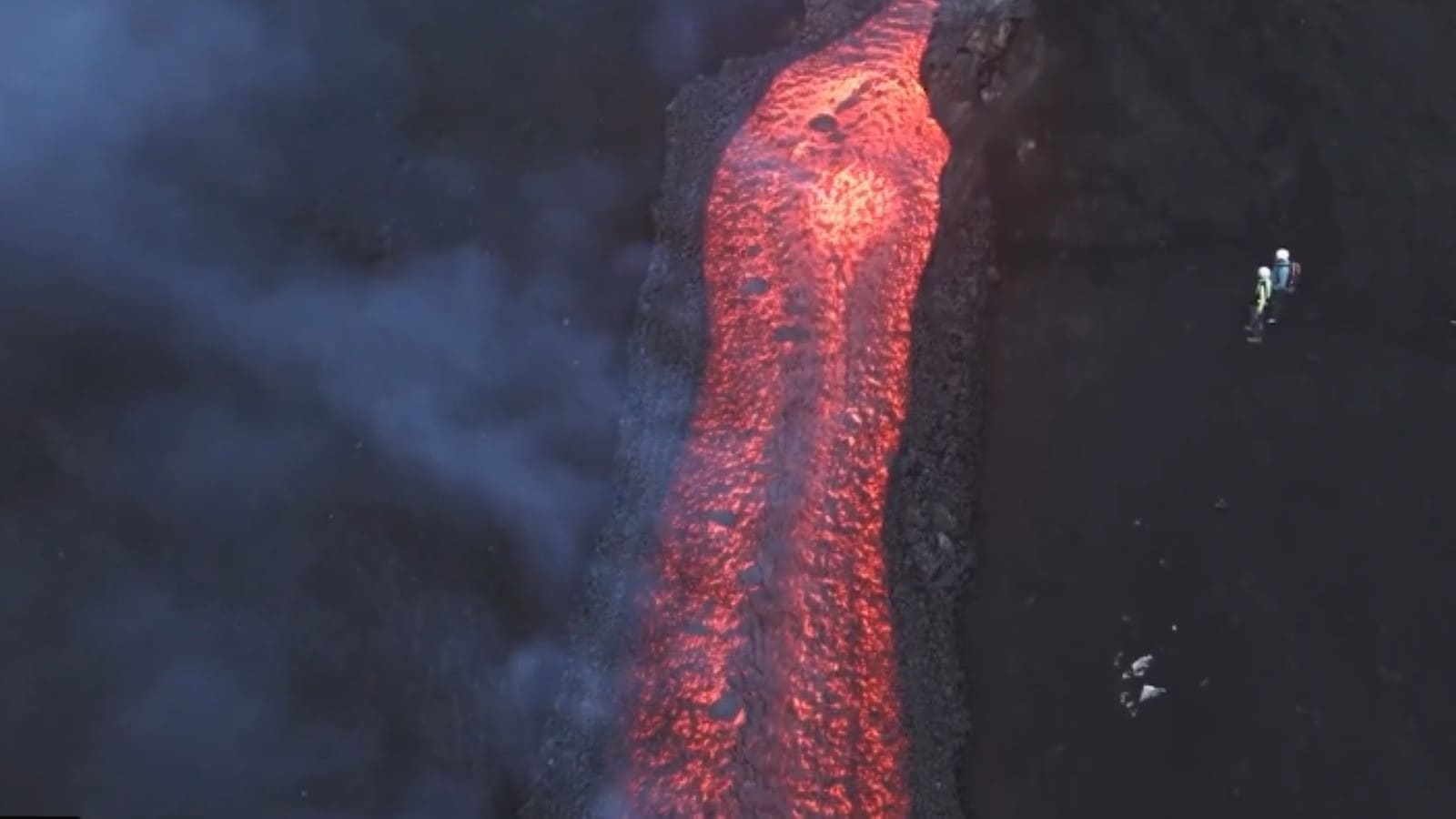
Sicily is glowing again. If you've looked at any news feed over the last few days, you've likely seen the striking footage of brilliant orange lava streams from Mount Etna slithering down darkened slopes. It looks magnificent. It looks terrifying. It looks like a perfect piece of social media clickbait.
But treating Europe's most active volcano as a mere visual spectacle misses the real story of what's happening on the ground.
When the Italian Civil Protection Department recently elevated the alert level from green to yellow, it wasn't a minor administrative update. The decision followed an intense increase in volcanic tremors recorded by the National Institute of Geophysics and Volcanology (INGV). A vent opened on the eastern flank of the mountain at an altitude of roughly 3,000 meters above sea level, sending molten rock into the uninhabited Valle del Bove. While international headlines focus entirely on how pretty the liquid fire looks against the night sky, locals and geologists are focused on things that actually matter, like ash plumes, shifting flight schedules at Catania International Airport, and the erratic plumbing of a mountain that has been erupting for over 2.6 million years.
You don't understand Etna just by looking at a photo of glowing rocks. You understand it by looking at how this giant interacts with the communities built right on its flanks.
The Real Science Behind the Orange Glow
Most people assume all lava is the same. It's not. The vivid orange hue that dominates the current footage tells scientists a lot about the temperature and composition of the current flow.
When lava first escapes a fissure on Etna, it typically registers at temperatures hovering around 1,000 degrees Celsius. At this heat, the molten rock emits that bright orange-yellow light. As it crawls down the slope and meets the cooler air of the Sicilian high altitudes, it loses heat. The color shifts down the spectrum, turning to a deep, sluggish red, and eventually crusting over into a solid black rock called basalt.
The current activity is largely effusive rather than purely explosive. This means the pressure inside the volcano is venting through a crack, letting the lava stream out like toothpaste from a tube instead of blasting the entire mountaintop into the stratosphere.
Geologists track these movements using highly sensitive tiltmeters, satellite radar, and acoustic sensors that listen to the deep infrasound rumbles inside the mountain. When magma rises, it literally swells the mountain. The ground tilts by fractions of a millimeter. If you don't know what you're looking for, you miss it completely. But to the team at the INGV station in Catania, those tiny movements are an early warning system that saves lives.
What Most People Get Wrong About Volcanic Risk
There's a common misconception that the biggest threat from an active volcano is getting consumed by a fast-moving wall of fire. Hollywood loves this trope. In reality, you can usually outwalk a lava flow on Etna.
The real danger is much more subtle, messy, and airborne.
The Tyranny of Volcanic Ash
Lava rarely leaves the high-altitude zones of the mountain during these routine events. Ash, however, goes wherever the wind tells it to.
When gas bubbles expand violently within rising magma, they shatter the molten rock into tiny, microscopic shards of glass and mineral fragments. This is volcanic ash. It isn't like the soft ash left behind by a wood fire. It's abrasive, heavy, and completely impervious to water.
When an Etna plume drifts south or east, it blankets towns like Zafferana Etnea, Giarre, and the city of Catania itself. This presents immediate, exhausting problems:
- Road Hazards: A two-inch layer of ash turns asphalt into something slicker than ice. Driving becomes incredibly hazardous, and local municipalities frequently ban two-wheeled vehicles during ash falls.
- Roof Collapses: Because volcanic ash is dense rock powder, it weighs a tremendous amount. If an eruption is accompanied by rain, the ash absorbs water like a sponge. Old roofs across the Sicilian villages can collapse under the weight.
- Economic Paralysis: The Catania International Airport often has to shut down completely during heavy ash emissions. Jet engines cannot tolerate volcanic glass; it melts inside the combustion chambers and chokes the machinery. A single major ash cloud can strand tens of thousands of travelers and disrupt millions of euros in trade across southern Europe.
The Invisible Threat of Toxic Gases
Lava streams are accompanied by a massive release of volatiles. The mountain breathes out thousands of tons of sulfur dioxide, carbon dioxide, and hydrogen chloride every single day.
Carbon dioxide is particularly treacherous because it's completely odorless and denser than ambient air. It can collect in low-lying depressions, valleys, and basements around the base of the mountain. A person walking into one of these invisible pockets can lose consciousness within seconds due to lack of oxygen. Local shepherds and hikers have known about these dangerous zones for centuries, often tracking where wildlife mysteriously drops dead to map out the current gas hazards.
A History of Diverting the Flow
Humans have been trying to control Mount Etna for a very long time. In fact, the earliest recorded attempt to intentionally alter the path of a lava flow happened right here in 1669.
During that historic eruption, a massive fissure tore open near the town of Nicolosi. A slow, relentless river of molten rock marched straight toward the walls of Catania. Desperate to save their homes, a group of roughly fifty local men covered themselves in wet cow hides to shield against the blistering radiant heat. Armed with iron crowbars and picks, they marched up to the edge of the flow and hacked open a breach in the hardened side crust.
Their plan worked. The lava spilled out through the new gap, flowing away from Catania.
The plan worked a little too well, unfortunately. The diverted stream began heading directly toward the neighboring town of Paternò. The furious residents of Paternò armed themselves, marched out to the site, and drove the Catanian workers away at gunpoint. The breach crusted over, the lava resumed its original path, and it eventually breached the fortifications of Catania anyway, destroying a significant portion of the city.
That chaotic historical event established a long-standing principle in international volcanic management: you don't alter a flow if it shifts the danger to someone else's backyard.
Fast forward to 1983. Another major eruption threatened several mountain villages and a key tourist cableway. This time, engineers used explosives. They laid down hundreds of meters of water-cooled pipes and detonated shaped charges to breach a lava channel, successfully diverting a significant volume of the molten rock into an artificial trench. It was a massive technical feat, proving that modern engineering could influence a volcanic stream, though it remains a rare, last-resort strategy.
How the Locals Actually Live with an Active Giant
Outsiders always ask the same question when they see footage of the orange lava streams from Mount Etna: Why would anyone choose to live there?
To a Sicilian, the answer is simple. The mountain gives far more than it takes.
The Gift of Volcanic Soil
The very same ash that shuts down airports and ruins car paint jobs is filled with elements like potassium, phosphorus, and iron. Over centuries, these volcanic materials break down into some of the most extraordinarily fertile topsoil on Earth.
The lower slopes of Etna are packed with lush terraced vineyards, ancient olive groves, and sprawling citrus orchards. The wines produced here—particularly those made from the native Nerello Mascalese and Carricante grape varieties—are famous worldwide for their distinct, smoky minerality. Winemakers accept the persistent risk of a new fissure opening in their vineyard because the terroir is impossible to replicate anywhere else.
The Unique Microclimate
Rising to over 3,300 meters, Etna creates its own weather patterns. The mountain intercepts moisture rolling off the Ionian Sea, producing significant rainfall and winter snowpacks. This creates a strange island of alpine forests and ski resorts sitting directly above the warm Mediterranean coast. You can literally ski down the snow-covered volcanic fields in the morning and swim in the sea by afternoon.
The relationship isn't based on fear; it's based on profound respect. Locals don't even refer to it as a generic volcano. They call it "Idda"—a Sicilian dialect word meaning simply "She." To the people of Catania and the surrounding villages, the mountain is a living, maternal entity that demands vigilance but offers prosperity in return.
What to Do If You're Traveling to Sicily Right Now
If you're currently in Sicily or planning a trip soon to see the spectacle yourself, you need to abandon the idea of just winging it. A changing alert level means the mountain is volatile. Here's how to navigate the situation safely and responsibly.
Check Airport Status Every Morning
Don't rely on your airline's automated text alerts to tell you if flights are delayed. Keep the official Catania International Airport arrivals and departures page open on your phone. If the wind shifts and pushes the ash plume directly toward the runway, flight suspensions happen fast. Have a backup plan that involves taking a train or bus up to Palermo airport if you absolutely must catch an international connection.
Hire an Authorized Volcanological Guide
The upper peaks of Etna are strictly regulated. When the alert level moves to yellow, independent hiking above certain altitudes is banned by local prefectural decrees. If you want to get close to the active areas safely, you must go with a licensed guide.
These professionals know the terrain perfectly. They carry satellite communicators, gas masks, and have an intimate understanding of which valleys are safe and which ones are potential traps if a new vent opens. Trying to sneak past the trail closures to get a better photo for your feed is an easy way to end up stuck, injured, or facing a massive fine from the Alpine Rescue service.
Pack the Right Gear
Flip-flops and light sneakers are useless on a volcano. Volcanic rock is essentially shattered glass. It will slice through cheap fabric and thin soles within an hour of walking.
Bring sturdy, high-top hiking boots with thick soles. You also need windproof, layered clothing; temperatures at 3,000 meters are often near freezing, even when the coastal beaches are sweltering. Pack a basic dust mask and protective eyewear. If a sudden ash fall occurs, you don't want those sharp volcanic shards getting into your eyes or lungs.
Your Immediate Next Steps
Don't just stare at the news clips. If you want to track the current behavior of the mountain with the same accuracy as the experts, bookmark the official INGV Catania observatory website. They publish live thermal camera feeds that update every few minutes, alongside real-time tremor charts that show exactly how much magma is moving underground. Monitor local flight tracking boards if you have transit plans through southern Italy, and ensure any tour company you book with uses fully certified alpine-volcanological guides. The mountain is putting on a show, but safety relies entirely on looking past the pretty colors and respecting the raw science underneath.
This Mount Etna Eruption Video shows the exact glowing orange streams and the night sky illumination discussed above, offering a clear visual of the current effusive activity.