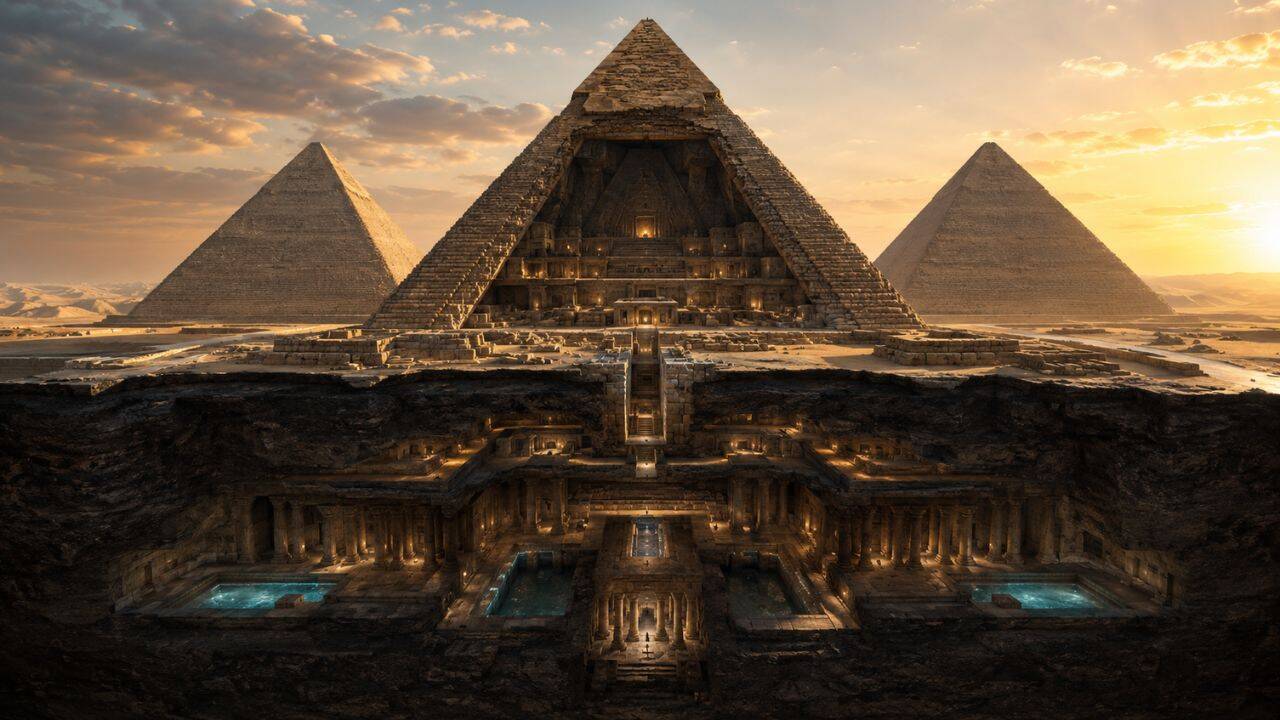
You think we know everything about the Giza Plateau. Decades of excavations, tourist buses, and textbook entries make it feel like Egypt's most famous desert has given up all its secrets. It hasn't.
Right next to the Great Pyramid of Khufu lies the Western Cemetery, a final resting place for Old Kingdom royalty and high-ranking officials. Most of it is packed with mastabas—flat-roofed, rectangular stone tombs. But for centuries, one specific plot of land remained completely empty, flat, and unremarkable.
A joint team of Japanese and Egyptian researchers decided to look closer at this blank space. They didn't bring shovels; they brought high-tech imaging gear. What they found under the sand isn't just an anomaly. It's a structural puzzle that defies easy explanation, and it might just be the entrance to something much larger.
The Sharp Angles of Giza's New Anomaly
Geology is messy. Nature doesn't like straight lines, and it rarely makes perfect right angles. That's why archaeologists stopped in their tracks when their scans revealed a massive, deliberate L-shaped structure sitting just two meters beneath the desert floor.
This thing is big—measuring about 10 by 10 meters. According to Motoyuki Sato, an electromagnetic sensing expert from Tohoku University who led the survey, the shape is too sharp to be a natural formation. Humans built this.
But here's the weird part. The scans show that the L-shaped space was filled in with sand after it was constructed. It was intentionally backfilled. Why build a massive, structured layout just to bury it immediately?
The team's best running theory is that this upper structure wasn't meant to be a tomb itself. It was an entrance.
Two Technologies One Massive Mystery
The team didn't just guess what was down there. They used two distinct remote-sensing methods between 2021 and 2023 to map the subsurface.
First, they ran Ground-Penetrating Radar (GPR). GPR works by bouncing electromagnetic waves off underground objects. It gave them a highly detailed look at the shallow L-shaped structure. But GPR has depth limits in dense terrain.
To look deeper, they deployed Electrical Resistivity Tomography (ERT). ERT maps how easily electrical currents pass through different materials. Dense rock like limestone resists current, while open voids or loose sand behave differently.
Directly underneath the L-shaped structure, the ERT scans lit up.
[Ground Level]
       |
       | (~2 meters down)
[====== L-Shaped Structure ======] (Filled with sand)
       |
       | (~5 to 10 meters down)
[?????? Highly Resistive Void ??????] (Possible chamber/walls)
Between 5 and 10 meters below the surface, the instruments detected a second, highly resistive anomaly. It matches the 10-by-10-meter footprint of the structure above it. The data points to a massive subsurface space, potentially filled with a mixture of sand, gravel, or completely empty air voids. The researchers believe the upper L-shape directly connects to this deeper mystery.
Why the Location Changes Everything
To understand why everyone is losing their minds over this, you have to look at the neighborhood. The survey area sits directly south of mastaba G4000. That happens to be the tomb of Prince Hemiunu.
Hemiunu wasn't just any royal family member. He was King Khufu’s vizier and the man widely believed to be the mastermind behind the construction of the Great Pyramid itself.
In a cemetery reserved for the absolute elite of the Old Kingdom, leaving a massive, prime piece of real estate completely blank makes zero sense. Unless, of course, it wasn't blank at all. The fact that this structure is hidden underground—unmarked by any traditional aboveground mastaba tomb—suggests it was either deliberately concealed or built for a purpose that didn't follow standard funerary rules.
Some experts note that while L-shaped offering chapels exist elsewhere in Giza, they are almost universally built above ground. Finding one buried, backfilled, and acting as a roof for a deeper, unexplained mass is entirely new territory.
What Happens Next
Naturally, the internet went wild with rumors of a massive new hidden temple or an untouched royal burial chamber. Egypt's Supreme Council of Antiquities had to step in, reminding the public that a radar anomaly is not a confirmed treasure room. Ashraf Mohie El-Din, Director-General of the Giza Plateau, clarified that the scans show a cavity, but its true contents remain unconfirmed until shovels hit dirt.
Excavations have already begun. Archaeological teams are currently working through the layers of sand to physically uncover the L-shaped structure and find the path leading down into the deeper resistive anomaly.
If you want to track the progress of this discovery, skip the speculative social media threads. Keep an eye out for updated excavation reports published in peer-reviewed journals like Archaeological Prospection, where the initial joint Japanese-Egyptian study first dropped. The ground at Giza is finally talking, and the real answers will come from the dirt, not the rumor mill.