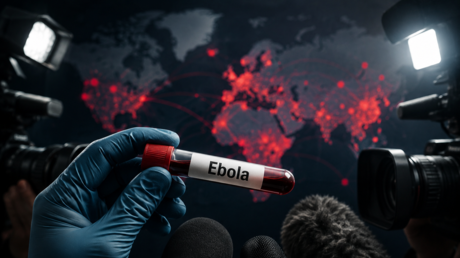
Whenever the word Ebola hits international news headers, a very predictable wave of panic follows. People immediately visualize the terrifying imagery of the 2014 West Africa crisis or the plot lines of Hollywood biothrillers. We picture an unstoppable virus that causes instant, widespread devastation. But right now, as a major outbreak surges in the Democratic Republic of Congo, the global community is focusing heavily on the name of the pathogen while completely missing the real reasons this crisis is getting out of hand.
The fear is real, but it is directed at the wrong target.
As of late June 2026, the situation on the ground in the eastern provinces of the Democratic Republic of Congo has turned grim. Health authorities have confirmed 1,048 laboratory-verified cases and 267 deaths. The infection has spilled across the border into neighboring Uganda, and modeling data published in international medical journals flags a massive 70 percent probability that it will enter South Sudan next if containment fails.
Yet, the standard playbook we built over the last decade to fight Ebola is failing us. Why? Because the threat has mutated in a way that clinical toolkits alone cannot fix.
The Blind Spot of Existing Vaccines
The first massive misconception centers around medical readiness. Many global observers assume that because scientists successfully developed highly effective vaccines like Ervebo during previous crises, an Ebola outbreak is now a solved scientific problem.
That is dangerously incorrect.
The Ebola virus isn't a single entity. It belongs to a viral family with several distinct species, and the current outbreak in the Democratic Republic of Congo is driven by the rare Bundibugyo strain. This specific strain has only flared up a couple of times in recorded history—once in Uganda back in 2007 and again in Congo in 2017.
Here is the kicker. The vaccines sitting in global stockpiles were engineered specifically to target the Zaire strain, which caused the massive historic epidemics. Against the Bundibugyo strain, those vaccines offer zero protection.
We are fighting a completely different beast with an empty chemical toolkit. There are no approved vaccines, no specific antiviral treatments, and no rapid, on-the-spot diagnostic test kits designed for Bundibugyo. When a suspected patient walks into a clinic, doctors cannot just run a quick strip test. The lack of customized diagnostic tools is one of the main reasons the virus managed to spread completely undetected for nearly six weeks when the outbreak quietly started around April 1. By the time health officials officially declared the emergency on May 15, the virus already had a massive head start.
Gunfire and Displacement Camps
If you want to understand why this virus is spreading so rapidly, you have to look away from the microscope and look at the geopolitical reality of eastern Congo. Pathogens do not exist in a vacuum. They thrive on human chaos, and eastern Congo has that in abundance.
The epicenter of the current crisis is Ituri province, which has logged 954 of the confirmed cases. The rest are scattered through North Kivu and South Kivu. This region is a literal war zone, besieged by brutal conflicts involving armed rebel factions like the Allied Democratic Forces and the M23 movement.
When a village is attacked by rebels, people do not stay at home to maintain a public health quarantine. They run for their lives. Thousands of families are currently fleeing mining towns like Mongbwalu and crowding into massive, ad-hoc displacement camps like the one in Kigonze.
Imagine trying to stop a highly infectious virus in a refugee camp that holds tens of thousands of traumatized people. There is no running water. There are no proper latrines. The hygiene conditions are abysmal, creating an absolute paradise for a virus that spreads through contact with bodily fluids. In May alone, dozens of people exhibiting severe hemorrhagic symptoms died in the Kigonze camp within a 48-hour window before medical teams could even set up a isolation perimeter.
Furthermore, the conflict creates a severe security nightmare for health workers. Doctors Without Borders and local containment teams are facing immense community distrust. When health workers show up in full-body protective suits, demand to isolate sick relatives, and deny families the right to perform traditional burial washings on infected bodies, anger boils over. Medical teams have been physically attacked during contact-tracing missions. In cities like Beni, response teams have had to pull back entirely during active rebel raids, leaving infected individuals to flee into the surrounding forests or neighboring towns, carrying the pathogen with them.
The Tragic Cycle of Panic and Neglect
The international community has a remarkably short memory when it comes to biological threats. During the height of the COVID-19 era, world leaders repeatedly promised to fund global pandemic preparedness so we would never be caught off guard again.
Instead, the global funding trajectory has gone backward. In recent years, major global donors, including the United States, have aggressively cut back on official development assistance and reduced funding for global health security frameworks. Key public health infrastructure designed to monitor and manage emerging pathogens abroad has been quietly dismantled or starved of resources.
This is the classic, tragic cycle of global health—total panic when a disease hits the headlines, followed by absolute neglect the moment the immediate threat fades from western television screens.
The World Health Organization and local African health agencies are left holding the bag with severely diminished resources. We knew that another Ebola lineage would inevitably spill over into human populations. It was entirely predictable. Yet, international financing mechanisms remain deeply under-powered, leaving regional hospitals without the basic bio-safety level facilities required to manage a highly lethal pathogen safely.
Moving Past the Empty Rhetoric
Stopping the spread of the Bundibugyo strain requires a massive shift in how we approach global health emergencies. We cannot keep relying on the assumption that a single silver-bullet vaccine will save us every time.
First, international research consortiums must immediately fast-track clinical research into cross-reactive treatments that can mitigate multiple strains of filoviruses simultaneously. Relying on strain-specific countermeasures leaves us dangerously vulnerable to the natural diversity of the viral world.
Second, pandemic response plans must integrate geopolitical and humanitarian realities directly into their blueprints. Sending medical teams into active conflict zones without robust security, community liaison frameworks, and immediate investments in basic sanitation infrastructure like clean water and latrines for displacement camps is a recipe for catastrophic failure.
Finally, wealthy nations need to look at funding global health security not as a charitable handout that can be chopped during budget negotiations, but as a core component of national defense. A pathogen circulating in a crowded displacement camp in Ituri province is only a flight away from any major global city.
The current surge past 1,000 cases in Central Africa is a harsh reminder that the world remains profoundly unready for biological threats. We are tracking old ghosts while ignoring the complex reality of modern outbreaks.