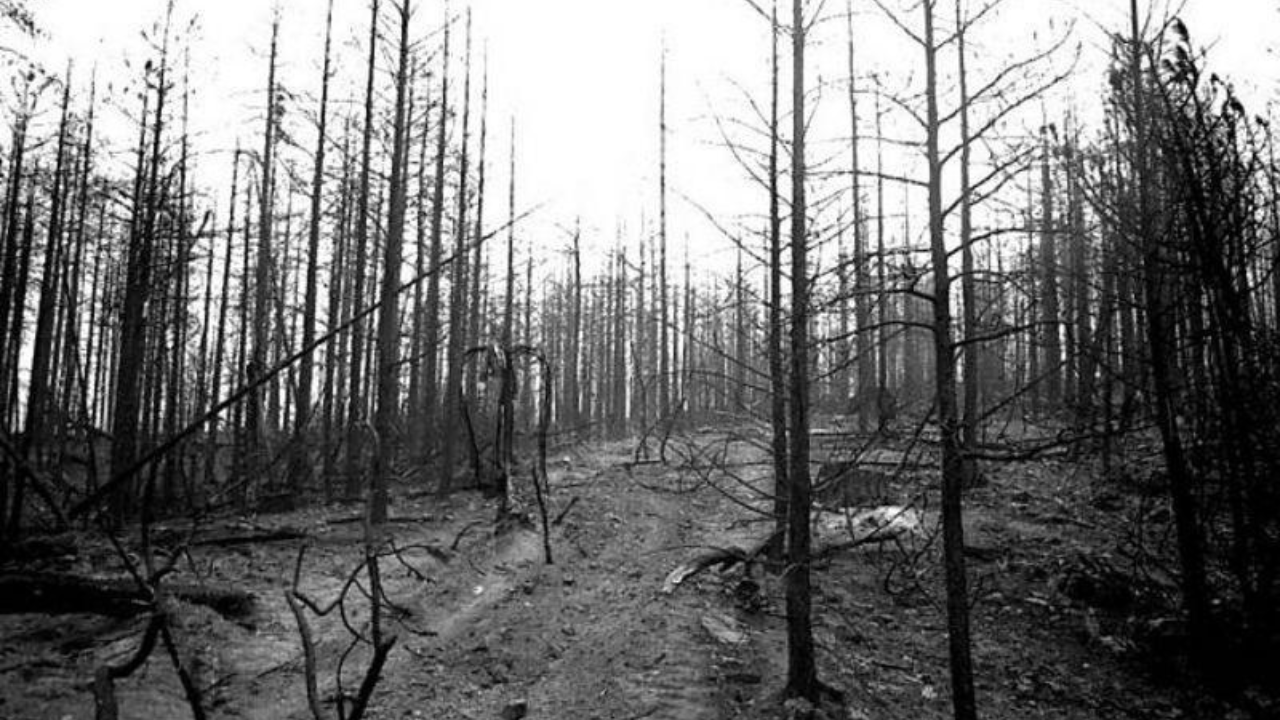
If you drive down Creek Road outside Ojai, California, after midnight, your headlights will cut through some of the thickest, eeriest oak canopies in Ventura County. Most locals know exactly what happens when you pull over near San Antonio Creek Bridge. You turn off the engine. You roll down the windows. You wait for the scent of burnt skin and the sound of something dragging its feet toward your car door.
That is the Char-Man.
For decades, California teenagers and horror fans have treated this desolate stretch of road as a rite of passage. The story always points back to a massive real-life disaster, the 1948 Wheeler Fire, which scorched thousands of acres. But while the fire was terrifyingly real, the urban legend that grew from its ashes has mutated into something else entirely. Most people think it is just a classic campfire ghost story, but the truth about how this myth started, and why it refuses to die, tells us a lot more about human psychology than it does about the supernatural.
The Tragedy Behind the Myth
The Wheeler Fire of 1948 was not a fable. It tore through the mountains above the Ojai Valley, leaving behind blackened hillsides and a deeply rattled community. In a small town surrounded by highly flammable brush, a wildfire is a shared trauma.
The most common version of the legend says that a father and son were trapped in their remote cabin as the flames surrounded them. The father died, but the son survived, horribly disfigured and driven mad by the pain. In a fit of delirium, the son allegedly flayed his father's body before disappearing into the wilderness. Ever since, he has been known as the Char-Man, a vengeful spirit or feral hermit covered in peeling, blackened skin, waiting to attack anyone who calls out for help.
Local folklore has spun several other versions over the years. Some swear he was a husband who lost his mind after watching his family burn. Others claim he was a firefighter caught in a sudden blaze, or even a motorist trapped in a burning vehicle on the winding mountain roads.
What the Records Actually Show
Here is where the campfire stories fall apart. If you look at historical documents from Ventura County, there are no police reports, no old newspaper clippings, and no coroner records from 1948 that mention a father being killed by his son in a remote cabin.
The murder never happened. The monstrous flaying incident is entirely fictional.
Folklore experts point out that when a community goes through a major disaster, it naturally looks for ways to process the fear. The sheer destructive power of the Wheeler Fire left an emotional scar on Ojai. Over the generations, that collective anxiety morphed into an oral tradition. We see this all over the country. Communities take a historic tragedy and compress it into a tangible monster. It is much easier to fear a single boogeyman hiding in the woods than it is to face the random, chaotic reality of a massive wildfire.
The Real Man Behind the Monster
There is another twist to the Char-Man story that many old-school Ojai residents still talk about. During the mid-twentieth century, there was a real human being who lived in the area and inadvertently kept the legend alive.
An elderly local man suffered from a severe skin condition that caused intense peeling and discoloration. He lived a quiet life but frequently took walks along Creek Road in the evenings to avoid the harsh California sun.
Imagine driving down an unlit, winding mountain road at night in the 1960s or 70s. Your headlights catch a glimpse of a tall, frail man with heavily peeling skin walking along the shoulder. You are already primed to think about the local ghost stories. You panic, hit the gas, and tell your friends that you just saw the Char-Man. This real, innocent resident became the physical proof that the teenagers needed to keep the myth alive, turning a harmless neighbor into a nighttime terror.
The San Antonio Creek Bridge Ritual
Today, the myth functions as a local endurance test. Teenagers head out to San Antonio Creek Bridge, now widely known as Char-Man Bridge, to dare each other to get out of the car. The ritual requires you to stand on the bridge in pitch darkness and call out his name or shout for help.
People swear they smell smoke out of nowhere or hear rustling in the dry brush. Of course, the Ojai Valley is full of wildlife, from raccoons to deer, which easily explains the noises. The smell of smoke is often just the hyper-reactive imagination of someone who is terrified.
If you want to explore the area yourself, skip the midnight ghost hunting and check out the local hiking trails during the day instead. The Ojai Valley land conservancy preserves thousands of acres of gorgeous, rugged terrain. Just remember that the real danger in these hills isn't a burned monster from 1948. It is the very real, ongoing threat of modern wildfires. Keep your wits about you, respect the dry landscape, and leave the campfire stories where they belong.