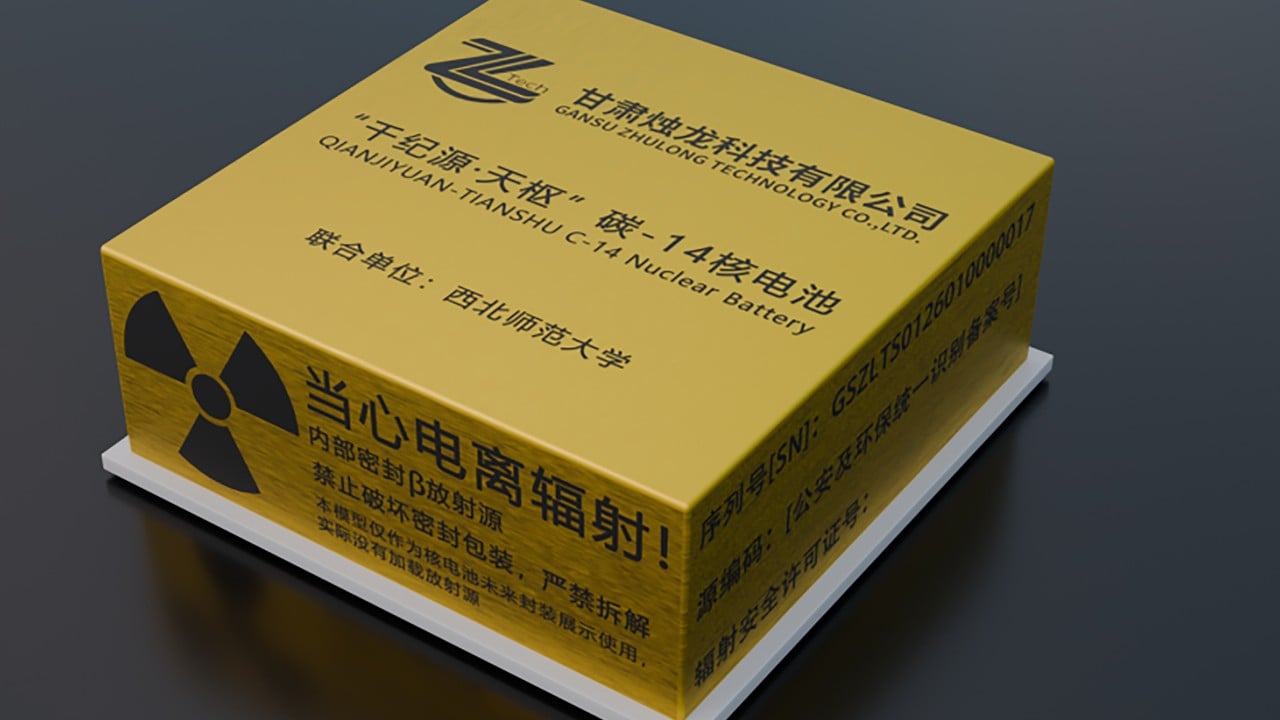
Most people hear the phrase nuclear battery and immediately picture a miniature sci-fi reactor powering a smartphone for a lifetime. That's not what is happening here. When news broke that Chinese researchers achieved a microwatt milestone with a self-reliant carbon-14 nuclear battery, internet forums lit up with wild expectations. Let's clear the air immediately. This technology won't run your laptop or your electric vehicle. It isn't meant to.
The real breakthrough lies in extreme longevity and self-reliance. A joint research team from Northwest Normal University and Wuxi Beta Pharmaceutical Technology successfully built an engineering prototype called Zhulong No. 1, or Candle Dragon One. It marks a massive leap forward in micro-nuclear battery tech, but it operates on a scale of microwatts and nanowatts. Understanding exactly what this device does explains why it's a massive deal for deep-space missions, medical implants, and isolated sensors. If you enjoyed this piece, you might want to look at: this related article.
The Reality Behind the Microwatt Milestone
The Zhulong No. 1 isn't designed for high power. It's designed to never stop. During laboratory testing, the prototype registered a short-circuit current of 282 nanoamps, an open-circuit voltage of 2.1 volts, and a maximum output power of 433 nanowatts.
Those numbers sound tiny. They are. Yet, the energy density reaches 2200 megawatt-hours per gram. That is roughly ten times the density of standard lithium-ion batteries. Because carbon-14 has a radioactive half-life of 5,730 years, this tiny cell can theoretically supply a steady trickle of electricity for centuries. For another angle on this story, check out the recent update from Engadget.
The team proved the battery's real-world utility by linking it to energy storage modules. It successfully sustained a Bluetooth radio frequency chip, enabling it to transmit and receive signals without an external power source. They also hooked it up to an LED light that has flashed over 35,000 times during four months of continuous operation.
How Silicon Carbide Traps the Energy
Conventional electronics rely on chemical reactions that degrade quickly. Nuclear batteries use betavoltaic technology. As the carbon-14 isotope decays, it naturally emits beta particles, which are fast-moving electrons.
The brilliance of the Zhulong No. 1 is its structural composition. The researchers encased the radioactive carbon-14 source directly inside a silicon carbide semiconductor. When beta particles strike the silicon carbide, they create electron-hole pairs, generating a continuous electric current.
Safety is a common concern when people read about nuclear power. This design answers that issue directly. Silicon carbide acts as a highly effective shield. It completely absorbs the low-energy beta radiation emitted by carbon-14, ensuring zero radiation leakage outside the battery housing. Testing conducted by the Hefei Institutes of Physical Science confirmed that the device is entirely safe for deployment. It functions perfectly in brutal environments, managing temperatures ranging from minus 100 degrees to 200 degrees Celsius with a degradation rate under 5% over fifty years.
The Secret Supply Chain Advantage
An outstanding lab prototype means nothing if you lack the raw materials to mass-produce it. This is where the strategic angle becomes obvious. Historically, countries struggled to secure a steady domestic supply of carbon-14, often relying heavily on specialized foreign imports.
China systematically eliminated that bottleneck. The China National Nuclear Corporation successfully produced its first commercial batch of carbon-14 isotopes at the Qinshan Nuclear Power Base. They utilized heavy water power reactors to irradiate targets and extract the isotope at scale.
By vertical integration of the isotope supply chain with semiconductor manufacturing, the production of these batteries becomes viable. They aren't relying on external suppliers for the core radioactive material. This domestic fuel pipeline is the true driver behind their rapid development milestones.
Where This Technology Actually Gets Used
You won't find a carbon-14 cell in consumer retail stores anytime soon. Instead, look at environments where replacing a battery is either physically impossible or prohibitively expensive.
Pacemakers and brain-computer interfaces require reliable, decade-long power sources. Current medical implants demand invasive surgeries just to replace depleted lithium cells. A safe, encased carbon-14 cell could power a pacemaker for the patient's entire life.
Consider deep-sea monitoring networks, polar research stations, and space probes. Out past Mars, solar panels lose their effectiveness. Traditional thermal nuclear batteries are large, heavy, and hot. A coin-sized betavoltaic battery offers a lightweight alternative to keep vital sensors, clocks, and transmitters running indefinitely on interstellar voyages or lunar outposts.
Moving Past the Lab Phase
The next challenge isn't proving the physics. The physics works. The challenge is scaling the output from nanowatts to milliwatts to broaden the scope of practical applications. The research group is already working on the Zhulong No. 2 prototype, which aims for fully enclosed cells with higher power outputs.
If you are tracking advanced energy systems, stop looking for consumer phone batteries. Keep your eyes on the sensor networks and specialized hardware that keep the modern world moving behind the scenes. Watch the development of silicon carbide semiconductors and isotope refining capacity. Those are the real metrics that dictate who wins this long-term technological race.