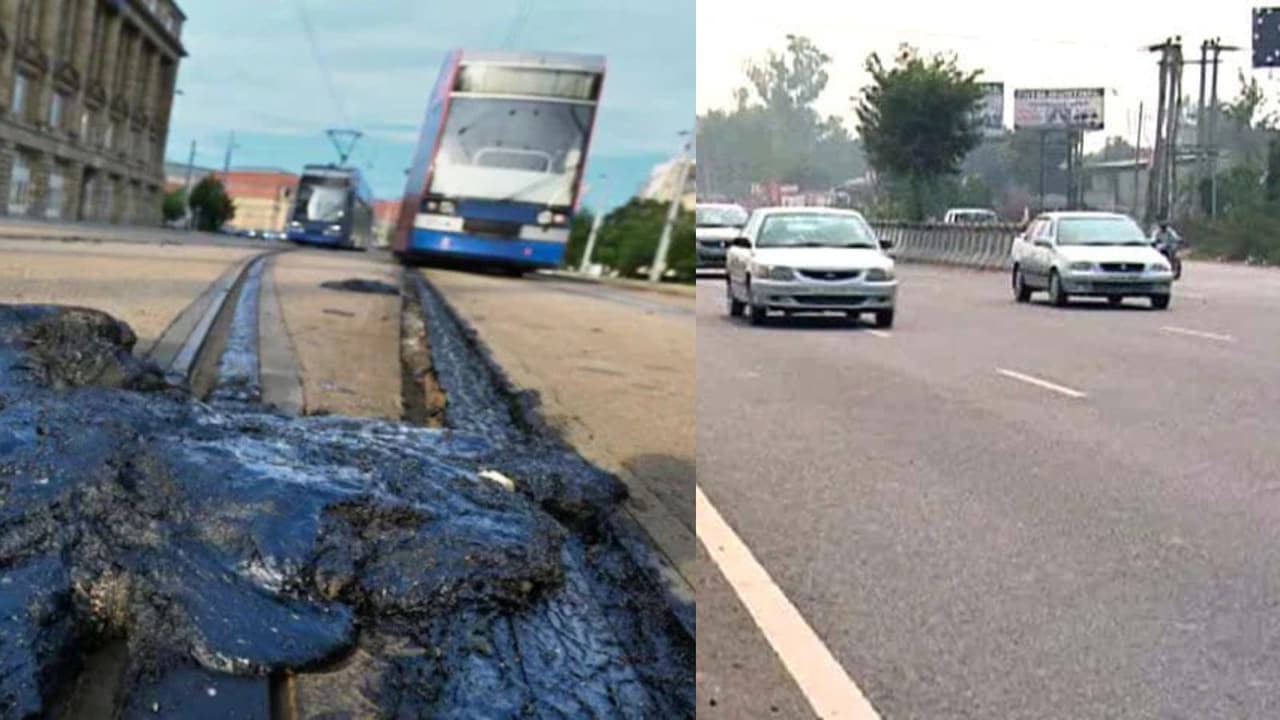
When summer heatwaves hit the United Kingdom and temperatures crawl toward 40 degrees Celsius, things fall apart. Trains slow to a crawl because steel tracks buckle. Airport runways crack. Most bizarrely, the actual streets start turning into sticky, black goo.
Social media instantly fills with mockery. People in places like Delhi, Cairo, or Phoenix laugh. They endure 45 degrees Celsius for months without their highways liquefying. They wonder if British engineers are incompetent. They want to know why UK roads melt at 40 degrees while roads in India survive grueling, blistering heat.
The answer is not bad engineering. It is deliberate, math-driven design.
A road is not just a slab of rock. It is a highly specialized chemical mixture tailored to a specific climate baseline. When you build a road in northern Europe, you design it to survive the worst enemy it faces ninety percent of the time. That enemy is not heat. It is freezing, bone-chilling winter water.
The Chemistry Behind Why UK Roads Melt at 40 Degrees
To understand this infrastructure failure, you have to look at what asphalt actually is. Your local street is roughly ninety-five percent aggregate, which means crushed rock, sand, and gravel. The remaining five percent is bitumen.
Bitumen is the black, sticky petroleum byproduct that binds the rocks together. It is a visco-elastic material. This means its physical properties change completely depending on the temperature. It behaves like chocolate. When it is cold, it gets hard, stiff, and brittle. When it gets hot, it softens and flows.
British road builders traditionally use a formula called Hot Rolled Asphalt. This mix features fine aggregates and a relatively high percentage of bitumen. The bitumen selected for the UK is intentionally soft. It has a high penetration grade. This choice ensures that when British winters drop below freezing, the road stays flexible. If the road stays flexible, it can bend slightly under the weight of heavy trucks without cracking.
If the UK used hard bitumen, the winter cold would make the streets brittle. They would shatter under traffic, creating millions of immediate potholes.
India faces the exact opposite problem. Most regions in India experience relentless, crushing summer heat with mild winters. Indian engineers use harder bitumen grades, specifically Viscosity Grade 30 and Viscosity Grade 40. These binders require immense heat just to soften. They combine this hard binder with bituminous concrete made of much larger, interlocking stone aggregates. The structural stability comes from the stones jamming against each other, locked in place by a rigid binder.
When the ambient air hits 40 degrees Celsius in London, the dark asphalt absorbs solar radiation like a sponge. The road surface temperature easily climbs twenty degrees higher than the air. A 40-degree day means a 60-degree road. That temperature flies right past the softening point of standard British bitumen, which sits around 50 degrees Celsius. The binder turns into liquid grease. Traffic then rolls over it, pushing the soft stones around, creating dangerous ruts and bleeding lines of tar.
The Financial Reality of Infrastructure Design
You might wonder why the UK government does not just switch to a harder asphalt mix nationwide. Climate change is making intense heatwaves more frequent, so changing the recipe seems logical.
It is a matter of economics and probability.
The UK has roughly 250,000 miles of paved roads. Re-engineering every single mile to handle Indian-level heat would require adding polymer-modified binders to the asphalt mix. These polymers act like chemical stabilizers. They raise the softening point of the road to eighty degrees Celsius while preserving winter flexibility.
They also cost a fortune.
Currently, less than five percent of all UK road surfaces use polymer-modified asphalt. These high-grade materials are reserved exclusively for major motorways and high-traffic arterial routes. The vast majority of local roads, country lanes, and residential streets use cheap, basic asphalt mixes. These roads were built decades ago when a 40-degree summer in England was statistically unthinkable.
Replacing all of them would bankrupt local councils. It makes zero financial sense to spend billions upgrading minor roads for a weather event that happens two or three days a year, especially when that upgrade might make the same roads more vulnerable to winter frost heave.
Gritting in July and Other Emergency Fixes
When the tar starts bleeding, highway authorities have to deploy an emergency tactic that looks completely absurd to outsiders. They send out winter gritters in the middle of summer.
Instead of spreading salt to melt ice, these trucks spread dry granite dust or fine sand over the sticky highways. The sand acts like an absorbent blanket. It mixes with the soft, rising bitumen, soaking up the excess liquid and creating a temporary, stable crust. It stops car tires from stripping the top layer of the street away.
It is a messy, primitive fix. It leaves roads dusty and loose for weeks. But it keeps traffic moving without requiring a multi-million-pound resurfacing project.
The Approaching Infrastructure Crisis
The current strategy is hitting its breaking point. Climate baselines are shifting faster than municipal budgets can adapt. Pavement engineers are realizing that designing infrastructure based on historical weather data from the twentieth century is a recipe for systemic failure.
If heatwaves become an annual occurrence lasting weeks instead of days, the cumulative damage to soft asphalt will be catastrophic. Repeatedly softening and hardening ruins the internal bond of the pavement. The road loses its structural integrity permanently, leading to rapid widespread failure when winter rains return.
Engineers are testing warm mix asphalt and alternative fiber reinforcements to bridge the gap. These materials allow for lower installation emissions and slightly better thermal windows. But wide adoption is incredibly slow.
Your Immediate Action Plan for Heatwave Driving
If you are driving in a region experiencing unprecedented heatwaves on old infrastructure, you cannot treat the road normally. The environment has changed, and your driving habits must change with it.
First, check your tires immediately. Soft, bleeding asphalt reduces friction significantly. Combine that with the fact that high ambient heat increases your tire pressure, and you have a recipe for sudden blowouts and terrifying braking distances. Drop your speed by at least ten miles per hour on local roads when the tarmac looks glossy or wet.
Second, avoid the edges of rural roads. Heavy vehicles push soft asphalt outward, creating deep ridges along the shoulders. If your tires catch one of these ruts, it can pull your steering wheel right out of your hands. Stick to the center of the lane where the compaction is most uniform.
Third, wash your car promptly if you drive through a treated zone. That fine granite dust mixed with sticky bitumen will bake onto your wheel wells and undercarriage like industrial cement. Once it hardens, removing it without damaging your paint or braking components becomes an expensive nightmare.
:max_bytes(150000):strip_icc():focal(629x0:631x2)/serena-williams-best-fashion-48-b299a306ee5549dcb0ec248380d0df39.jpg)