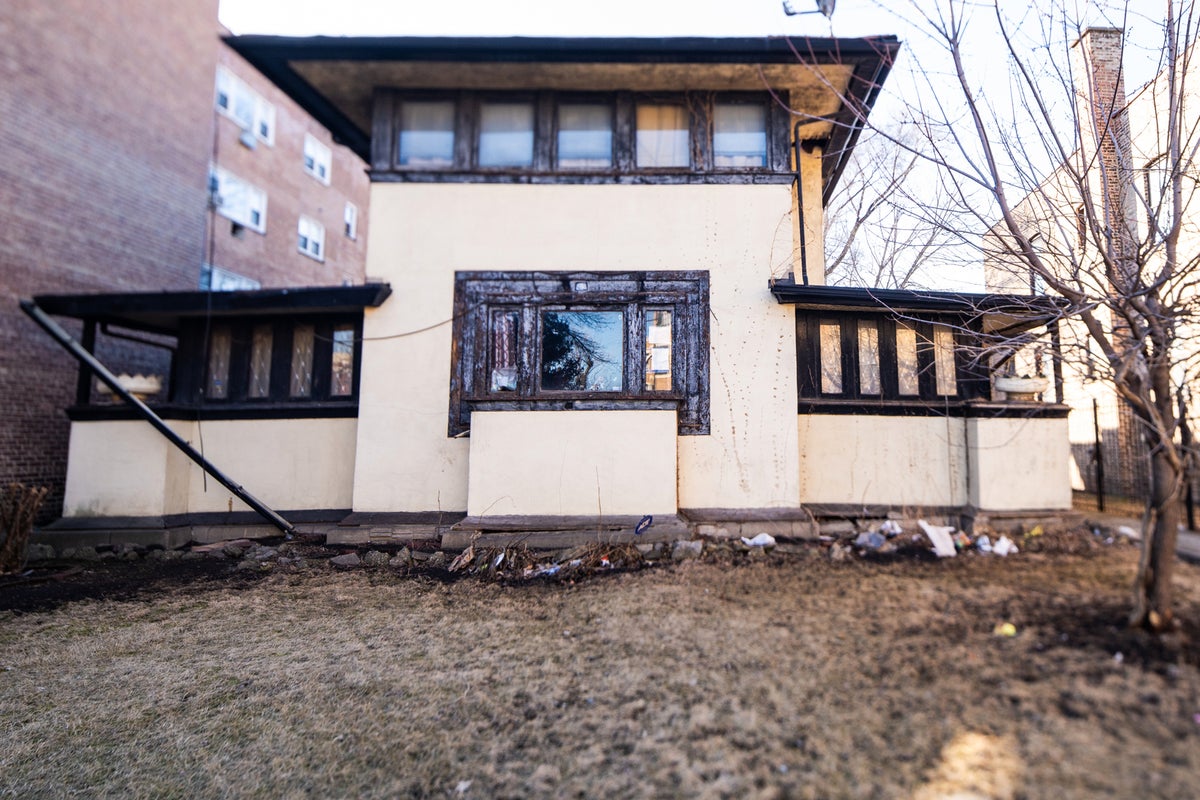
You don't expect to find a Frank Lloyd Wright masterpiece rotting in plain sight on Chicago’s West Side.
If you drive down Central Avenue in the South Austin neighborhood, you’ll mostly see commercial storefronts and multi-family apartment buildings. Tucked between them sits a building that looks completely out of place. It is small, dwarfed by its surroundings, and heavily weathered. For years, commuters passed it by without realizing it was designed by America's most celebrated architect.
That anonymity almost cost the city an irreplaceable piece of architectural history.
The J.J. Walser Jr. House, built in 1903, is Wright’s only single-family residence on Chicago's West Side. It spent years trapped in a downward spiral of legal limbo, structural decay, and shifting financial burdens. Now, a community-based nonprofit called Austin Coming Together (ACT) has stepped in to purchase the vacant landmark for $125,000, halting an impending foreclosure and offering a fragile lifeline to a structure on the brink of collapse.
This isn't just a story about real estate. It's an example of how historic preservation frequently fails communities that lack deep pockets, and why saving a neighborhood's identity requires more than just rich out-of-town donors.
The Limbo That Left a Landmark to Rot
When people think of Frank Lloyd Wright in the Chicago area, they envision the pristine, tree-lined streets of Oak Park or the meticulously restored Robie House in Hyde Park. Those properties enjoy robust institutional funding and steady streams of tourist dollars.
The Walser House didn't get that fairy-tale treatment.
Joseph J. Walser and his wife, Grace, commissioned Wright to build the home just four years after Austin was annexed by the city of Chicago. Over the next six decades, the property changed hands 11 times. Then, in 1970, a general contractor named Hurley Teague and his wife, Anne, bought the home.
For nearly 50 years, the Teagues were the only thing standing between the house and the bulldozer. Hurley used his skills as a contractor to keep the property in excellent repair despite decades of systemic economic disinvestment in the surrounding neighborhood. When he passed away in 1997, maintaining a century-old wood-frame house became an overwhelming financial burden for Anne.
To cover the mounting costs of preservation, Anne did what many elderly homeowners do. She took out a reverse mortgage.
When Anne passed away in 2019, that financial decision created a massive crisis for her heirs. The accumulated interest on the reverse mortgage quickly ballooned, making it impossible for the family to retain ownership. The house fell into a legal vacuum. Vacant, neglected, and trapped in stewardship limbo, the property faced a quiet foreclosure.
What Neglect Does to a Century Old Masterpiece
When a building sits empty without a clear owner, nature takes over quickly. The Walser House was officially listed on the 2025 Most Endangered Historic Places in Illinois list, and for good reason.
Water is the ultimate enemy of architecture. Photos of the interior revealed severe deterioration. Holes in both the foundation and the roof allowed rain and snow to pour directly into the structure for years.
If you talk to architectural historians, they'll tell you that Wright was a genius when it came to spatial flow, geometry, and aesthetic theory, but his structural engineering often left a lot to be desired. Even his well-maintained properties suffer from chronic water intrusion and roof sagging. When you combine Wright’s notoriously problematic flat-roof tendencies with years of total abandonment, the structural damage compounds exponentially.
The exterior overgrowth got so bad that the home was virtually invisible from the street. Local preservationists finally cleared the worst of the brush, but the underlying structural wounds remain wide open.
The Million Dollar Road to Recovery
Buying the house for $125,000 was the easy part. Fixing it is going to be a completely different battle.
Austin Coming Together has assumed full responsibility for the 123-year-old landmark, but their executive director, Darnell Shields, isn't sugarcoating the reality of the situation. Early projections suggest that a full, historically accurate restoration will cost anywhere from $2.5 million to $3.5 million. Some independent preservation advocates think that number could climb even higher depending on how much the foundation has shifted due to water damage.
The immediate next step isn't a beautiful aesthetic overhaul. It's emergency stabilization.
Phase 1: Emergency Stabilization (Patching holes, structural shoring)
Phase 2: Community Input & Visioning (Gathering neighborhood feedback)
Phase 3: Capital Campaign & Fundraising (Securing $2.5M - $3.5M)
Phase 4: Full Historic Restoration
ACT is currently working alongside groups like the Frank Lloyd Wright Building Conservancy and Landmarks Illinois to patch the holes, secure the envelope of the building, and stop the active bleeding. Only when the house is entirely stable can they begin thinking about the long-term future of the space.
Why This Preservation Fight Hits Different
Historic preservation has an equity problem. Wealthy neighborhoods get historic districts and tax incentives; working-class neighborhoods get demolition orders and empty lots.
The acquisition of the Walser House matters because of who bought it. ACT isn't an elite architectural foundation based in a distant city. They're a local collective impact organization deeply rooted in Chicago's West Side, known for stewarding local assets like the Aspire Center for Workforce Innovation.
For ACT, this project isn't about creating a cordoned-off museum where affluent tourists look at old furniture. It's about utilizing a historic asset to anchor local economic development, cultural pride, and education along the Central Avenue corridor. The goal is to create a community-serving space that honors Austin’s lived history while drawing visitors from nearby Oak Park to support local West Side businesses.
The Walser House is an early prototype of Wright's legendary Prairie Style. It proved that his radical architectural philosophy could be scaled down to fit a modest, urban footprint. If we only save the grand mansions of the ultra-wealthy, we lose the complete narrative of how modern architecture evolved.
What You Can Do Next
Preservation isn't a spectator sport. If you want to see the J.J. Walser Jr. House survive, here is how you can actually get involved:
- Track the progress: Avoid relying on occasional news snippets. Follow the dedicated Walser House updates via the Frank Lloyd Wright Building Conservancy website to see exactly where fundraising efforts stand.
- Support local stewardship: Look up Austin Coming Together and review their Austin Forward. Together quality-of-life plan to understand how this building fits into the broader economic revitalization of Chicago's West Side.
- Advocate for local landmarks: Look around your own city. Identify historic properties trapped in probate or reverse mortgage battles before they end up on an endangered list. Early intervention saves buildings; waiting for a miracle rescue usually results in a pile of bricks.