For decades, developing nations followed a predictable playbook. When superpowers clashed, you sat on the fence, collected development aid from both sides, and focused on domestic growth. It was called strategic hedging. It worked during the Cold War, and it worked during the early years of the US–China trade disputes.
It doesn't work anymore.
The global financial architecture has shifted underneath our feet. We aren't dealing with simple trade wars or explicit economic sanctions anymore. Instead, Washington and Beijing are deploying a much quieter, more toxic strategy: weaponized uncertainty. By keeping financial rules intentionally vague and enforcement highly selective, major powers are forcing international capital to do their policing for them. The result? Capital markets are preemptively choking off funding to neutral countries long before any formal sanctions are even announced.
If you run a business or manage assets in the Global South, the old rules are dead. Sitting out the new cold war is no longer a shield; it's a target.
The Death of Predictable Risk
To understand why everything changed, look at how global power used to operate. If a country misbehaved, a superpower slapped them with a trade embargo or locked them out of the SWIFT banking network. It was loud, public, and backward-looking. Investors could calculate the damage, adjust their risk models, and move on.
Today, Washington and Beijing rely on persistent ambiguity. They don't give you a clear line not to cross. They keep the boundary fuzzy on purpose. Consider how the US handles secondary sanctions or tech export controls. The rules change monthly, often dictated by executive whim rather than long-standing legislation.
This isn't accidental bureaucracy. It's a structural feature designed to paralyze decision-making.
When the rules of global commerce are unpredictable, international banks and asset managers don't wait to see what happens. They don't have the stomach for "probabilistic" compliance penalties. Instead, they de-risk. They quietly pull capital out of any developing country that looks like it might get caught in the geopolitical crossfire tomorrow. The punishment happens ex ante—before any actual law is broken.
The Broken Trilemma of Development
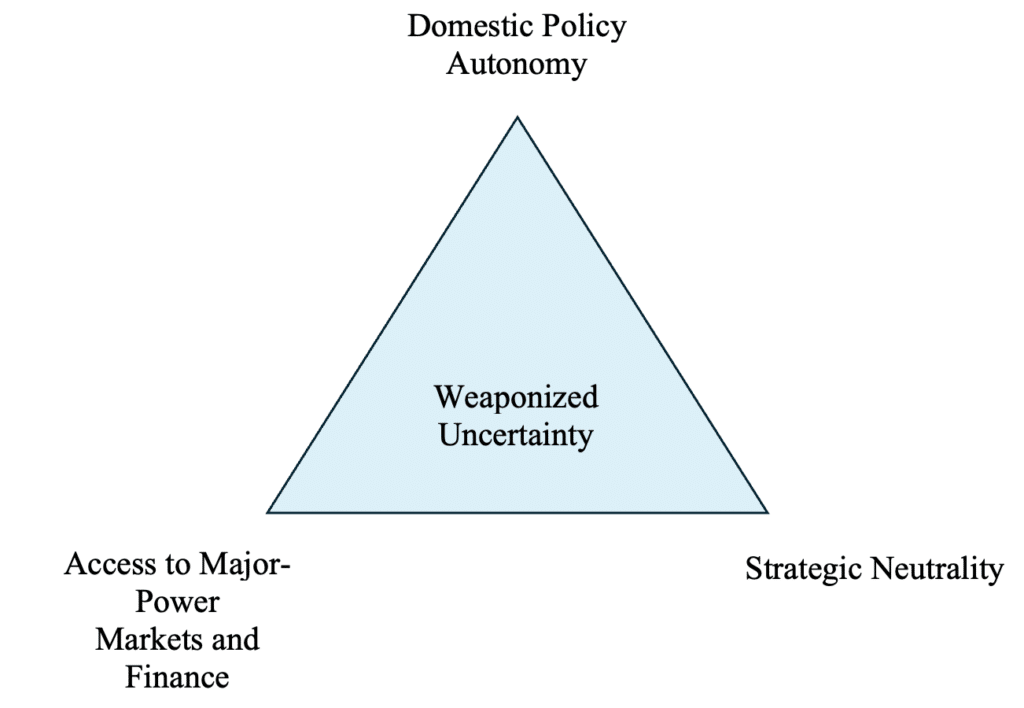
For any emerging economy, long-term survival relies on balancing three distinct goals:
- Maintaining access to Western financial markets, dollar clearing systems, and major consumer hubs.
- Executing independent domestic industrial policies to lift citizens out of poverty.
- Staying strategically neutral to trade freely with both the West and the China-led bloc.
Historically, you could manage all three if you played your cards right. Weaponized uncertainty has turned this into an impossible trilemma.
Take strategic neutrality. In a rule-based global economy, neutrality signals safety. Today, it signals vulnerability. Because a neutral state has no formal security or financial umbrella from either superpower, it lacks guaranteed protection from sudden market exclusion. Financial markets see that lack of an umbrella and price it as an existential tail risk.
Say an Indian tech firm or a Brazilian agribusiness giant tries to build deep supply chains with both Silicon Valley and Shenzhen. Western compliance departments look at that Chinese exposure and start sweating. They don't cancel contracts immediately. They just choose not to renew long-term financing agreements. They shorten contract lengths. They demand higher interest rates to cover the political risk premium.
Without stable, long-term financing, your domestic industrial policy falls apart. You can't build deep-water ports, semiconductor fabrication plants, or green energy grids on short-term, high-interest capital. The mere threat of future economic coercion disciplines developing states far more effectively than actual coercion ever did.
Real Winners Don't Sit on the Fence
The standard counterargument is that some countries are thriving under this fragmentation. Look at Vietnam's manufacturing boom or Mexico's nearshoring windfall.
Look closer.
These aren't examples of successful neutrality; they are examples of forced, expensive adaptation. Vietnam's factories are running at maximum capacity, but they face constant gridlock, skyrocketing real estate costs, and the perpetual fear that Washington will suddenly target them for facilitating Chinese tariff circumvention. It's a stressful, fragile kind of growth.
The actual winners are those aggressively restructuring their financial insulation, not those pretending the old globalized world is coming back.
Central banks across Southeast Asia and Latin America are quietly shifting away from total dollar dependence. They aren't doing it out of ideological loyalty to Beijing or Moscow. They're doing it because holding pure US Treasury portfolios now carries an unacceptable level of political jurisdiction risk. They are diversifying into local currency settlement systems, physical gold, and multi-aligned regional financial networks to ensure their domestic economies can function when the next geopolitical trapdoor swings open.
Your Next Steps in a Fragmented Market
If your business operates across these geopolitical fault lines, hoping for a return to stable, rule-based global trade is a losing strategy. You must build your own insulation.
First, stress-test your capital stack for jurisdiction risk. If your primary funding sources or payment rails rely exclusively on a single superpower's financial node, you're exposed to their domestic political volatility. Diversify your banking relationships across regional hubs like Singapore, Dubai, or São Paulo that have demonstrated a capacity to maintain multi-lateral financial plumbing.
Second, ditch the "China Plus One" illusion if it just means assembling Chinese components in a different country. Western regulatory frameworks are moving toward strict rules-of-origin tracking, leveraging advanced data analytics to peer deep into supply chains. Aim for genuine input redundancy. Find alternative sources for critical raw materials and components, even if it hurts your short-term margins.
Efficiency used to be the only metric that mattered. Today, resilience is what keeps you solvent.