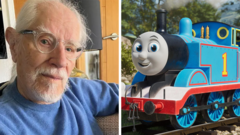
You probably think Thomas the Tank Engine belongs on the fictional Island of Sodor. Or maybe you associate his bright blue paint with the rolling hills of the British countryside where preservation railways keep steam alive. But the real story of how the world's most famous locomotive came to be is grounded in a much gritier reality. It belongs to the industrial heartland of the West Midlands.
If you dig into the history, Thomas wasn't born from an abstract creative spark. He was forged by the rhythmic, heavy clanking of wartime freight trains rattling through Birmingham during the Blitz.
The Birmingham curate who built an empire
In 1940, a young Anglican priest named Wilbert Awdry moved to Birmingham to take up a post as a curate at St Nicolas' Church in Kings Norton. It was a stressful time to move to the city. The Second World War was raging, and Birmingham's heavy manufacturing infrastructure made it a prime target for German bombers.
The rectory where Awdry lived sat less than a mile from the busy lines of the Birmingham West Suburban Railway. Night after night, as the air raid sirens wailed and the ground shook, Awdry lay awake listening to the sounds of steam engines working the nearby tracks.
To him, those sounds weren't mechanical white noise. They were conversations. He heard engines straining under the weight of heavy military freight, slipping on the wet rails, and barking out sharp bursts of steam as they helped each other up the steep inclines.
When his young son Christopher caught a severe bout of measles in 1942, Awdry did what any exhausted parent would do. He started making up stories to keep the boy amused in bed. He took those late-night railway conversations he'd been tracking from his bedroom window and turned them into characters.
The first tales didn't even feature Thomas. They focused on Edward, Gordon, and Henry, published in 1945 as The Three Railway Engines. But Christopher wanted something concrete to play with, so Awdry got creative with wartime scrap materials.
The broomstick prototype
Because of strict wartime shortages, you couldn't just walk into a shop and buy a toy train set. Awdry had to build one from scratch. He found an old wooden broomstick, sawed off a section for the boiler, used scraps of wood for the framing, and painted the little 0-6-0 tank engine blue with yellow lining.
He wrote the letters "NW" on the side. When Christopher asked what the letters meant, Awdry joked that they stood for "No Where." Later, that throwaway gag evolved into the North Western Railway on the Island of Sodor.
When his wife Margaret encouraged him to publish a second book dedicated to this new little engine, the publisher hired an illustrator named Reginald Payne. Payne looked at Awdry's basic broomstick toy and decided it needed a real-world counterpart. He based the final design on a London, Brighton and South Coast Railway (LB&SCR) Class E2 tank engine.
How the West Midlands shaped the logic of Sodor
What sets The Railway Series apart from typical children's fiction is its strict adherence to real-world mechanical logic. Awdry wasn't just spinning whimsical yarns; he was a hardline railway enthusiast who co-wrote historical academic papers like The Birmingham and Gloucester Railway in 1987.
His deep knowledge of local infrastructure directly informed how his fictional engines behaved. Take the infamous Lickey Incline, located just south of Birmingham. It's the steepest sustained main-line railway incline in Great Britain. To get heavy trains up that bank, British railways used "banking engines"—smaller, powerful locomotives that pushed the train from behind.
This exact operational reality became a core plot point on Sodor. When Edward or the other engines get stuck on a hill, they need a banking engine to assist them. The petty rivalries, mechanical breakdowns, and strict hierarchies of the engines weren't fantasies. They were the daily dramas of the West Midlands rail network translated into children's prose.
Where to find the history today
If you want to track down these roots yourself, you don't need to look for a magical island. You just need a ticket to Birmingham.
Awdry left Birmingham in 1946, moving on to other parishes, but the core DNA of his creation never left the West Midlands. The billion-pound global franchise of books, television shows, and merchandise didn't start in a corporate boardroom or a quiet country study. It started because a stressed-out curate in a bombed-out city looked out his window, listened to the local trains clearing their throats, and decided to tell his sick son what they were saying.